Green Bean “Un-casserole”

The Reason:

I must admit, I am not a big fan of traditional green bean casserole. Actually, I am not a fan of cream-of-anything soup, which is what mars the green bean casserole for me. We’ve had this recipe for a long time, so I don’t remember exactly how we got it in the first place, but it is awesome, and I think everybody who tries it likes it. And those who don’t are probably filthy Communists*.

*I don’t actually believe Communists are any filthier than Capitalists. I meant to say filthy hippies**.

**Even though hippies do in fact tend to be filthy, how about we say “earthy” instead of “filthy”? Earthy hippies. Even hippies would be happy with that one. Except for the fact that earthy hippies would probably enjoy Green Bean Un-casserole.

The Journey:

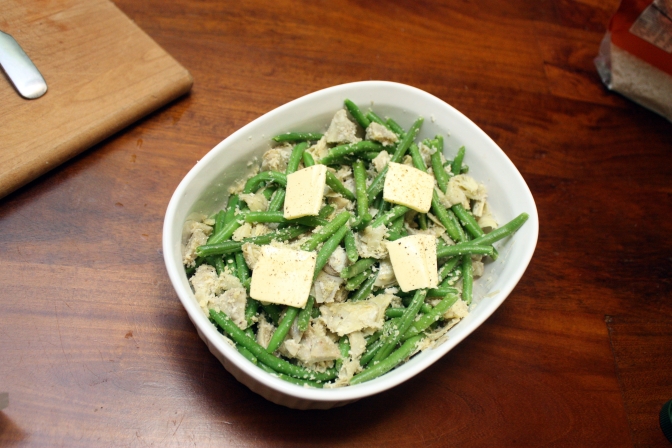
This is just flat out delicious, however, some people see green beans and artichokes, and they won’t even try it. So, in order to prove to you how delicious (and un-healthy) this is going to be, I’m going to show you a picture of Sara drizzling oil over garlic and cheese:

Aw, what the heck, let’s throw some butter on top too.

Are you with me now?

The Verdict:

This is soooo good. I could eat it by the gallon. It was probably the best part about Thanksgiving, which is a holiday entirely centered on delicious food. In fact, it was so good, that we ended up making a second batch the next day!

The other nice thing is that the recipe is easy to scale up. So if you need to serve it in large quantities (such as for Thanksgiving), you can easily just double or triple the recipe. Or quadruple it and eat it all yourself!

The Recipe:

I’m not sure where this originally came from, so I can’t credit the source. Sara changed it a little over the years, so I’m not sure how much it even resembles the original recipe.

  • ~1/2 lb. frozen green beans, semi-defrosted
  • 1 14 oz. can artichoke hearts, hand-squeezed (you need to remove the water) and chopped
  • 1 tbsp olive oil
  • 1/4 c parmesan cheese
  • 1/4 c bread crumbs
  • 1 cloves garlic, pressed

  • 2 oz French fried onions
  • 1 tbsp butter
  • Salt & pepper to taste

Combine 1st group of ingredients in casserole dish. Top with dots of butter and salt and pepper. Bake covered for 20 min at 400°F. Top with onions and bake uncovered for 15 min.

Homemade Yogurt and Granola Parfaits

The Reason:

When you tell people you’re making yogurt, you sound like some sort of super-hippie. But why not make your own yogurt? It’s *super* easy (as you will see below), and it’s cheaper than buying it (its about 1/2 to 1/3rd the price of buying yogurt). It’s healthy. It encourages you to eat more yogurt, which is a healthy habit. And if you’re making yogurt, you might as well make some homemade granola to go with it.

The Journey:

The craziest thing about making yogurt is how simple it is. It’s mostly just milk!

You can even save some of the yogurt from the previous batch as the culture to start the next batch, though I’ve heard that eventually the strain won’t be strong enough to continue without mixing in some fresh stuff from the store. I can’t verify that.
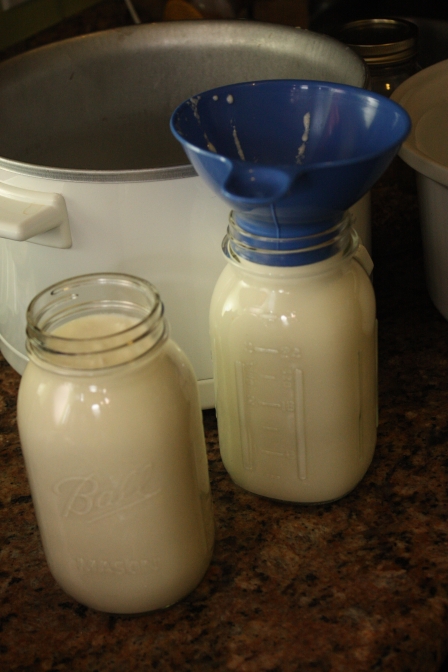
I will admit that making the yogurt takes a long time, but it’s not really active time. It’s not like you have to do anything during that time. It’s mostly just a matter of keeping it warm.

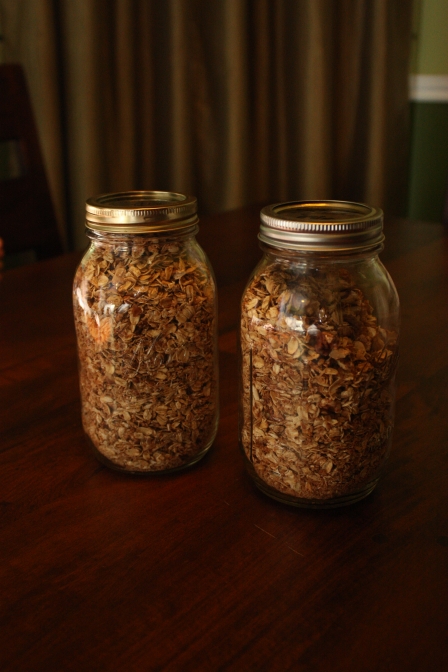
The granola could have been a post in its own right. Of course it gives a nice crunch to your parfait, but you can use it for anything you might use granola for. Sara eats bowls of it with milk for breakfast.
The Verdict:

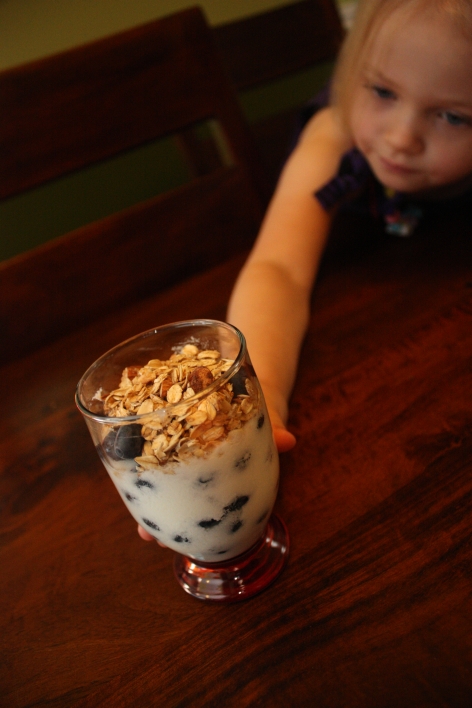
It’s great. The kids love it. The thing about yogurt is that it is so versatile. You can mix in honey, vanilla, or jam. You can have it with blueberries, strawberries, or mango. You can use it to substitute for oil in baking. You can decide how much to sweeten it, and after doing this for awhile, you won’t be able to go back to the super-sweet, store-bought variety. What’s not to love?

And that’s to say nothing of the granola, which has a million uses itself, even above and beyond yogurt parfaits. Make it with almonds, make it with dried fruit. Throw whatever you want in there. Yum!

Plus, you sound impressive when you say you make your own yogurt. Nobody has to know how easy it is. That’s between you, me, and the public Internet.

The Recipe:

Yogurt

This recipe is from Stephanie O’Dae’s A Year of Slow Cooking.

  • 8 cups of milk (half-gallon). We generally try for organic whole milk, but I think you could use anything (we have made it with 2% and couldn’t tell the difference).
  • 1/2 cup of plain yogurt (live/active culture).
  • That’s it. Seriously. Just milk and a little yogurt!
  1. Add the milk to the crock pot. Cook on low for 2 1/2 hours.
  2. Turn off the crock pot. Let it sit for 3 hours.
  3. Scoop out 2 cups of the warm(ish) milk from the crock pot, and mix that with the 1/2 cup of “starter” yogurt. Then put the whole thing back into the crock pot and stir.
  4. Cover the crock pot with towels and leave it overnight (at least 8 hours)

Maybe it’s because of the towels, which sort of force you to unwrap the thing like a present on Christmas morning, but it’s always something of a surprise / delight when you  get up to find yogurt in the crock pot! For some reason, it always seems like it’s not going to work. Maybe because it’s so easy…a little TOO easy!

Granola

This recipe is from Mark Bittman, although any recipe for granola is really more of a suggestion than a recipe. So I’ll give you his recipe, but I’d say we make it a little different every time (as intended!).

  • 6 cups rolled oats (not quick-cooking or instant)
  • 2 cups mixed nuts (you can probably use anything, but we usually use chopped walnuts or almonds)
  • 1 cup shredded coconut (optional)
  • 1 teaspoon ground cinnamon
  • 2 teaspoons vanilla
  • 1 /2 to 1 cup honey or maple syrup (we usually do 1/2 cup that is a mix of honey and maple syrup)
  • 1 cup chopped dried fruit (such as raisins or dried cranberries)

We usually don’t actually put in the dried fruit, since we are usually using this in yogurt parfaits. You can always throw dried fruit in when you’re going to eat it, if needed. Also, we find that the coconut really adds something. We’ve tried it with and without, but after not having it and then putting it back in, I don’t think we’ll go back to leaving it out!

  1. Heat the oven to 350°F. Combine everything except the dried fruit. Spread evenly on a rimmed baking sheet and bake for 30 minutes or a little longer, stirring occasionally. The mixture should brown evenly; the browner it gets without burning, the crunchier the granola will be.
  2. Remove the pan from the oven and add the dried fruit (if you want to add dried fruit). Cool on a rack, stirring once in a while until the granola reaches room temperature. Transfer to a sealed container and store in the refrigerator; it will keep indefinitely.

We have also made the Spiced Granola from that page, which is the same as above, with the following additions:

  • Another teaspoon ground cinnamon
  • 1 teaspoon ground ginger
  • 1/2 teaspoon ground anise (we usually leave this out, mostly because we don’t have any anise)
  • 1/2 teaspoon cardamom
  • 1/4 teaspoon freshly grated nutmeg
  • 1/4 teaspoon ground cloves
  • 2 teaspoons vanilla extract

Coconut Tres Leches Cake

The Reason:

This recipe was specifically requested by Sara. A long time ago, we had a delicious coconut tres leches cake at a restaurant, and I promised to make one for Sara’s birthday. I almost forgot, but she didn’t! So here we are.

For the record, “tres leches” is Spanish for three milks, which will be demonstrated shortly.

The Journey:

The idea here is to make a very light and fluffy cake, which will absorb the milk mixture and turn into a nice, delicious, pudding-y mush. This is all about aerating everything, and in this case it requires separating the egg whites from the yolks. This is something I have always had a lot of trouble with, until Sara showed me the trick of doing it in the actual egg shell.

Basically, you just crack the eggs in half and then dump the yolk back and forth between the shells until all of the white is out. Seriously, I’ve tried all sorts of little tools and things, and they just never work. I can’t really explain why this works better, so you’ll have to take my word on it.

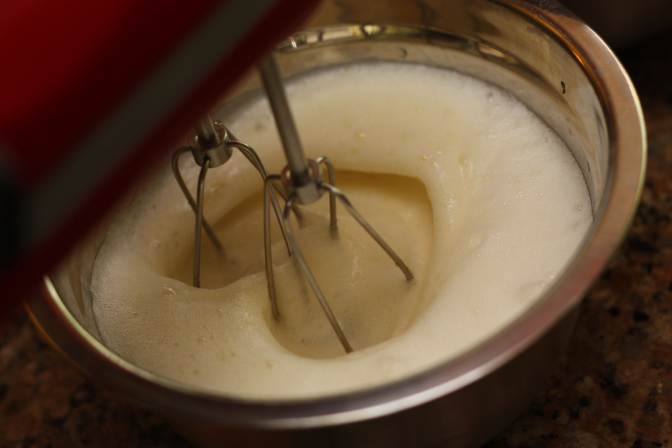
After that, it’s just a lot of mixing to put air in and make it light and fluffy.

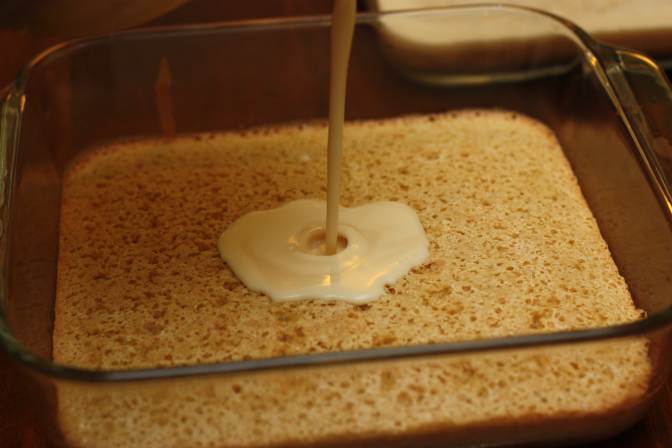
After the cake is baked, you poke holes in it and pour the milk mixture on top, to let it soak in. You’re going for that tiramisu-sort-of-texture, where everything is just soft and delicious.

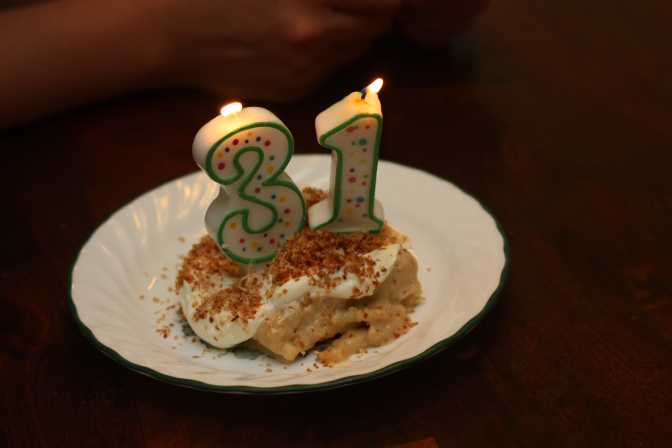
Note that this picture only shows a half recipe’s worth of cake, because we made two halves and froze one. We haven’t gotten out the frozen one yet, so I can’t vouch for it, but it certainly seems like the kind of thing that will do well frozen.

I do believe we made a full batch of the whipped cream and toasted coconut, which we didn’t need since we froze half. But wait a minute, what am I saying? When do you not need more homemade whipped cream and toasted coconut??

The Verdict:

It was awesome, and specifically a nice change of pace from a regular cake.

However, it wasn’t exactly perfect. I blame myself more than the recipe. The cake itself was a little dense, and I’m not sure why. Was it the substitution of whole wheat flour? Maybe I didn’t beat eggs enough? Perhaps the holes I poked with the toothpick were not quite big enough to let the milk soak in?

I don’t know. If anybody gets better results, let me know. But these were really minor issues and didn’t take away from the deliciousness at all. I think I’m just being hard on myself. But hey, I set a certain bar with Sara’s cake last year, and I wanted to do a good job!

The Recipe:

This recipe is adapted from chow.com.

  • Butter, for coating the baking dish
  • 1 cup all-purpose flour (we substituted whole wheat flour)
  • 6 large eggs
  • 1 cup granulated sugar
  • 1 (14-ounce) can sweetened condensed milk
  • 2/3 cup evaporated milk (not nonfat)
  • 1/2 cup unsweetened canned coconut milk
  • 1 tablespoon dark rum, such as Myers’s, plus more as needed
  • 1 cup sweetened flaked coconut
  • 1 1/2 cups heavy cream
  • 1 tablespoon powdered sugar
  1. Preheat the oven to 325°. Grease a 13-by-9-inch glass baking dish. Whisk the flour to aerate and break up any lumps (I didn’t do this, but maybe I should have).
  2. Split the egg whites and yolks into separate bowls. Add the sugar to the yolks and beat on high until pale yellow, about 5 minutes. Whip the egg whites on high speed until medium peaks form, about 1 1/2 minutes.
  3. Gently fold the egg whites into the yolks. Sprinkle the flour over the egg mixture and gently fold it in, just until there are no more white flour streaks. (Do not overmix.)
  4. Pour the batter into the prepared baking dish and bake until the cake is puffed and golden and the edges pull away from the sides of the pan, about 20 to 25 minutes.
  5. Meanwhile, place the three milks and the rum in a large bowl and whisk until combined.
  6. Remove the cake from the oven and place on a wire cooling rack. Using a toothpick or wooden skewer, poke holes all over the cake and allow to cool for 15 minutes. Pour the milk mixture evenly over the cake and continue cooling, about 45 minutes more. Tightly cover with plastic wrap and refrigerate at least 4 hours or overnight.
  7. When the cake is ready to serve, spread the coconut in an even layer in a large frying pan. Toast over medium heat, stirring often, until lightly browned and fragrant, about 5 minutes. Immediately remove from the pan.
  8. Place the heavy cream and powdered sugar in large bowl and whisk until medium peaks form. (If you like, flavor it with a teaspoon of dark rum. We opted to go rum-free on the whipped cream.) Slice the cake and serve topped with a mound of whipped cream and a sprinkle of toasted coconut.

Cold Brewed Coffee: Update

I did a First Friday Food post about cold brewed coffee a while back, but we had an amazing discovery which deserved an update! If you use cheese cloth instead of paper coffee filters, the filtering time goes from about 2 hours to about 1 minute! We still filtered the grounds out once with a mesh strainer, but with the cheese cloth you basically just pour the coffee through, no waiting. We couldn’t tell any difference in the final product.

It’s not very often that you can so easily improve your efficiency by 6000%! In fact, doing it this way seemed easier and faster even than using a Toddy. Plus you can reuse the cheese cloth, so you don’t even have to throw away the paper filters. It certainly changes making cold brewed coffee from, “you better really like it” to “why not?”

Sweet Potato Fries

The Reason:

Sweet potato fries are delicious, not to mention healthier than regular fries. This one is double good, since you’re not actually frying the french fries in oil. Believe me, this is a much better use of sweet potatoes than those gross, marshmallow-topped dessert/vegetable dishes so popular around Thanksgiving.

The Journey:

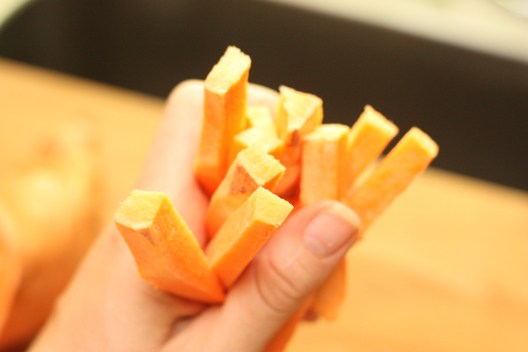
The hardest part about this is peeling and chopping the potatoes. Sweet potatoes have a much tougher, sort of papery skin than a regular potato does, so you definitely don’t want that in there.


For my money, you want these to be pretty decent size. I guess that’s just personal preference, but they shrink up a little bit in the oven, so you want to start bigger than you want.

Once you have them chopped up, the rest is easy. Mix them in a bowl, put ‘um on a sheet, and bake ‘um.

The Verdict:

They’re great. We make these all the time, so obviously we like them. The kids love them too. It’s sort of a race to get a hold of any, since everybody gobbles them up as fast as possible.

The Recipe:

Modified from Ingrid Hoffmann’s Sweet Potato Oven Fries recipe.

  • 3 large sweet potatoes, peeled and cut into strips
  • 2 teaspoons olive oil (significantly reduced from original recipe!)
  • 1 teaspoon paprika
  • 1/2 teaspoon chili powder
  • 1/2 teaspoon ground coriander
  • Coarse ground rock salt and freshly ground black pepper (optional, but we didn’t use any)

Preheat your oven to 450 degrees F.

Place the sweet potatoes in a large bowl and toss with olive oil until the sweet potatoes are coated. Add the paprika, chili powder, coriander, salt, and pepper; toss to distribute evenly.

Arrange the coated fries in a single layer on the prepared pan. Bake for 20 minutes on the lower rack until the sweet potatoes soften. Transfer the pan to the upper rack of the oven and bake 10 minutes longer, until fries are crispy.