The highest honor a writer can achieve
My flash story, “O What Freedom, This Great Steel Cage” is in the May issue of Analog, on sale at fine newsstands now.

I want to point out Ian Creasey‘s name on the cover there. This is significant to me personally because years ago, I used to subscribe to a couple of magazines, including Asimov’s. Alas, I had to stop subscribing when I realized that I just wasn’t keeping up with my subscriptions. That stack of unread magazines has sat by my bed ever since, and the one on the top of the stack is the August 2010 issue of Asimov’s.
For SIX YEARS I have stared at the cover of that magazine, the contents seeping into my brain by osmosis as I slept. SIX YEARS of staring at those names, including (you guessed it) Ian Creasey.
I have since met Ian online, so naturally I sent him this picture of me snuggling with my August 2010 Asimov’s:

Very happy to be once again appearing in such a prestigious magazine, and to be sharing a table of contents with Ian.
Peter Pan was kind of a dick.
I mean, all of Neverland exists solely so he can play out his fantasies. Whatever he wants, he gets: kick ass tree house, mermaids, fairies. He wants adventures, so he gets pirates…regardless of what the pirates think of the matter. Even if the pirates were real people with real lives, and people who cared for them, and maybe, just maybe hoping for one more chance to redeem themselves from some really terrible deeds…too bad! Peter says you’ve got to come and let him trounce you for all eternity, so that’s your new life. Bad luck fellows!
Neverland is a paradise, but only as long as you’re Peter. If you’re a pirate, it’s a fate worse than death.
Hop on over to the Spring issue of The Sockdolager and read all about it. And if you prefer the entire issue in an easier to read format, you can do that too (might I recommend the print edition?)

I am very please to announce that my story “Never” is set to appear at The Sockdolager.
What exactly is a “sockdolager” you muse, and then immediately feel foolish for speaking aloud to an empty room. Ah ha, but that’s where you’re wrong: the microphone in your computer secretly transmits all sound back to me, here in “Is This Thing On” headquarters.
A “sockdolager” is a forceful blow, or an exceptional thing or person.
The Sockdolager is a very small publisher.
We publish genre fiction that’s quite good & mostly short. You can read some, if you like.
And then they have an old timey picture of a fine lady about to wipe the pencil moustache off of a gentleman with her serious krav maga skills….so, my kind of place.
(Seriously, left yourself wide open to the ol’ knee-in-the-junk follow through there, dude)
More details as they become available; tentatively look for the spring issue.
I just finished reading “On Writing” by Stephen King. This is the first writing book I’ve read since I really started writing, and it was kind of interesting to read it at this stage of my career. It was certainly a different perspective than if I had read this book six or seven years ago. Six or seven years ago, I would have taken this book as the bible and carefully memorized every passage, faithfully soaking up every gospel truth it had to offer.
Reading the book now, I can see where old Uncle Stevie is full of shit.
When you’re first starting out, there is a lot of information out there for you. Pearls of wisdom are handed out like candy at Halloween, except it’s not the good kind of candy, it’s the cheap peanut butter things in the orange and black, unlabeled wrappers. Whenever two or more new writers are gathered, someone will nod sagely and say something like, “Show, don’t tell!” or “Write what you know!” or “Kill your darlings!”
The funny thing about these writing maxims is that the people who need them most don’t really understand them. By the time you really understand them, they’re no longer helpful to you. Write what you know, except you don’t know anything about living on a spaceship, or sword fighting, or zombies, and really who would want to read a story limited to only the things you actually *know*? Show, don’t tell, except for when you should show instead of tell, and kill your darlings except for the ones that are what make the story work, the ones that make the story uniquely you, or the ones that are the reason you wrote the whole damn thing in the first place. Follow these rules and never mind all the bestselling counter-examples. Do all of those things when you should do them, and don’t do all of those things when you shouldn’t.
The fact is, you can break any rule you’ve ever heard in writing, as long as you do it well.
Anybody who tells you there is only one way to write is probably trying to sell you a book about writing. Mr. King mostly gets this right, and generally couches his advice with plenty of “this might not be the only way to do it, but it is the way *I* do it”‘s. And really, most of his advice is spot on. You could certainly do worse than to follow his advice to the letter, and not only because he’s Stephen King, but because he’s generally right.
But when he says something like, “I believe plotting and the spontaneity of real creation aren’t compatible”, well, I call shenanigans (and I will refrain from mentioning a few novels of his that could have used a little more plotting and a little less “let’s let the characters decide where this is heading!”).
Mr. King goes on to say that plot is,
“…clumsy, mechanical, anticreative. Plot is, I think, the good writer’s last resort and the dullard’s first choice. The story which results from it is apt to feel artificial and labored.
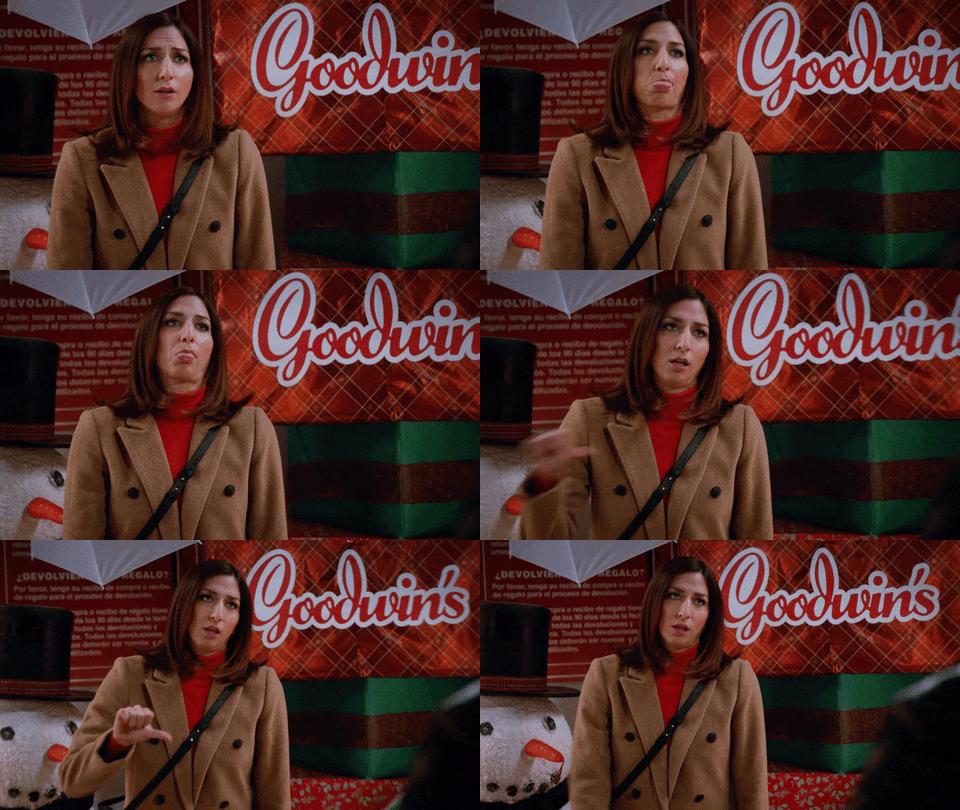
My response looks something like this:
The thing is, though, old Uncle Stevie is exactly right (and still full of shit at the same time).
Writers mostly don’t know precisely how we do what it is we do, and we’re mostly afraid of examining it, lest we break it. It’s more or less working, but we don’t know how. We do, however, know it’s fragile, so we’re sure as hell not going to go around shaking it to see what’s inside.
Inside each of our brains is a massively intelligent, and massively unharnessed, subconscious mind that is many, many times more powerful than our active, conscious mind. That subconscious mind understands how to tell a story implicitly. It generates ideas, it fleshes out characters, it knows about plot, and theme, and foreshadowing, and everything else that goes into storytelling. Only problem is that we can’t access it on purpose.
People often come up to me and say, “Oh, I loved the significance of X, and it was brilliant the way that you played into the themes of Y” and I used to say, “Oh…I guess I never thought about that.” Usually they slowly shake their head and walk away, totally disappointed in me as a writer. But I’ve come to realize that while *I* didn’t think about that, my subconscious absolutely did. Not in so many words, but again, it understands story in a fundamental way. It knows that good stories have themes and arcs and resonance. It doesn’t understand how, it just knows that this part needs to be highlighted, or repeated, or done in threes. And it is very sneaky about getting those types of things into the story.
Mr. King can say he doesn’t “plot” all he wants, but his subconscious does. Just because he’s not doing it in his active fore-brain, doesn’t mean he’s not doing it. People call it all kinds of things; insight, their “muse”, talking to their characters or letting their characters do what they want to do, “channeling” the story from the great beyond, etc. I’ve never been able to tell if people really believe this stuff or not; they really do talk like they believe it, but then I’ve never seen anyone get on stage and then refuse to accept an award because *they* didn’t write the story, after all.
I mean, it is true to a point: your subconscious is a strange, elusive beast, and coaxing things out it is a little bit like magic, and a little bit like communing with a higher power (by which I mean aliens). It’s like trying to kill Medusa without ever actually looking at her directly. Whatever you do to accomplish that, more power to you.
If you have to write in a closed room like Mr. King, or in complete silence, or with ACDC pounding on the stereo, or suspended upside down with ropes typing on an old Selectric I…I mean, it’s going to be difficult for you, but go ahead and rig yourself up. There is no right or wrong way to write.
Here’s where Mr. King gets it absolutely, 100% right. He says,
I think we’re actually talking about creative sleep…Your schedule…exists in order to habituate yourself, to make yourself ready to dream just as you make yourself ready to sleep by going to bed at roughly the same time each night and following the same ritual as you go.
and
Your job is to make sure the muse knows where you’re going to be every day from nine ’til noon or seven ’til three. If he does know, I assure you that sooner or later he’ll start showing up, chomping his cigar and making his magic.
It’s basically a kind of hypnotism: your writing rituals, whatever they are, signal to your subconscious (your “muse” in this case) that you’re ready to dream. Come out, come out, wherever you are, ollie ollie oxen free! We’re here, and we’re in the right frame of mind. We’re susceptible. (Finally! An explanation for why I require my magic writing pen!)
Old Uncle Stevie certainly would not disagree with me that the story is the king. However you arrive at that story, whatever rituals you require to summon your subconscious, you do you. Whether you outline (as I do) or let your subconscious handle that part, whether you start with theme and symbolism or work those in on revision, and whether you work at a small desk under the eaves in a quiet room with the door shut, or scribbling long hand in a notebook while in the middle of a crowded train (as I do), it is the right thing to do. You do you, and write on with your bad self. And if you read a book of writing advice, take the parts that make sense, and ignore the ones that don’t.
Even if the advice is coming from someone whose books have sold over 350 million copies.


 Shane Halbach