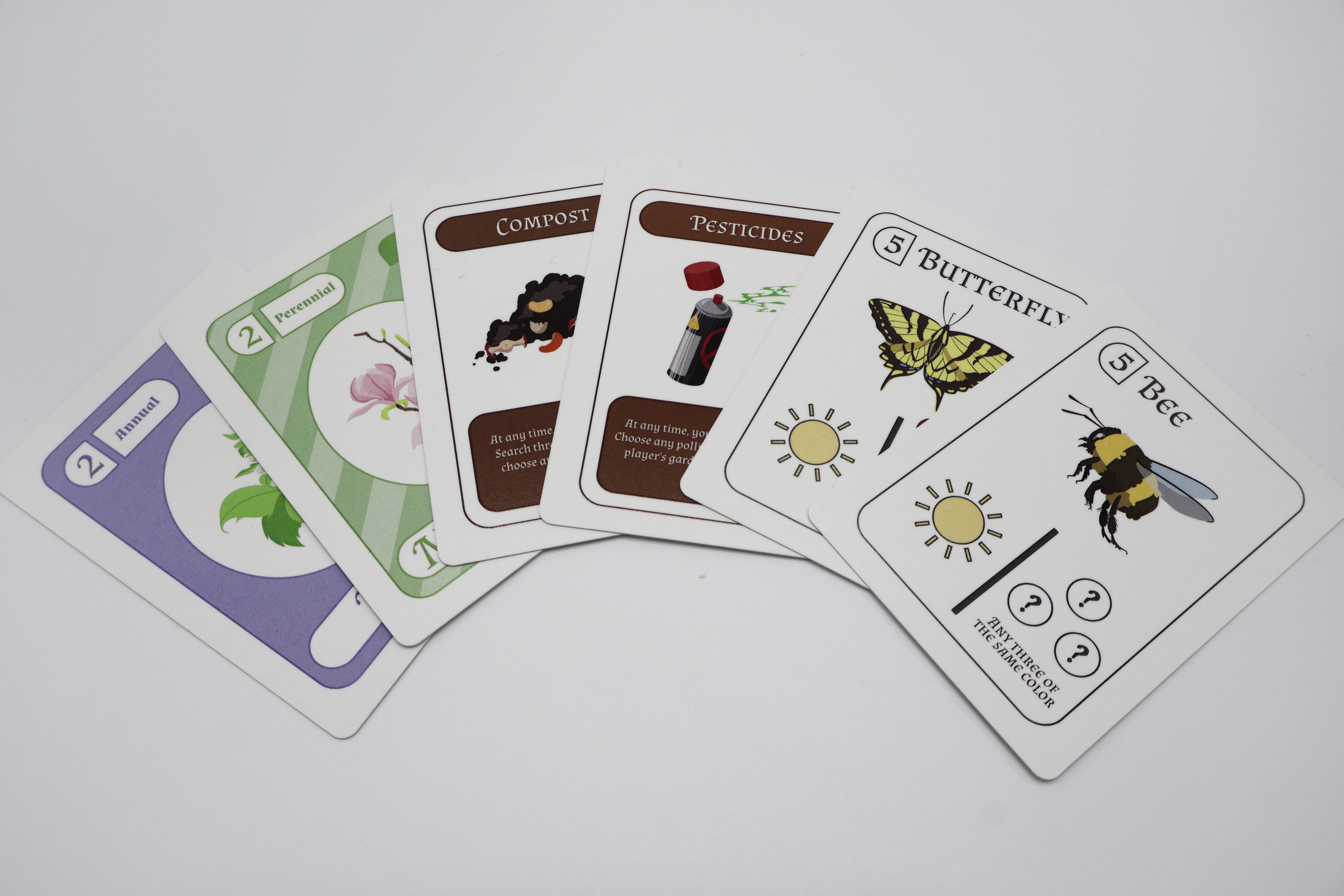
EcoFrenzy – The Pollination Game!

Fresh off of her win at the YEA Investor Panel last month, Evelyn is proud to announce that her website is now live, and her game is officially available for purchase!

($29.99 plus tax, shipping, and handling)

EcoFrenzy is a card-based, family, strategy game for all ages, combining elements of set collection and resource management to teach about pollinators and the environment. Build your garden with annuals and perennials, attracting different types of pollinators and even stealing them from opponents. But don’t make them too angry, or you might find a Heat Wave or Cold Front headed your way! Plant enough flowers or attract enough pollinators and you might get a biodiversity bonus.

For friends and family, or those local to Chicago, Evelyn is planning on having a stock of games on hand this summer and might be able to save you some shipping and handling. But if you can’t wait, you can order now! (Just be aware it does take a while to manufacture and ship, until Evelyn can build up her stock.)

As longtime readers of this blog know, Evelyn has long been a Butterfly Girl, hatching Eastern Black Swallowtails on the back porch (and sometimes catching more than butterflies in her net!).

Therefore it should come as no surprise, Evelyn’s company, EcoFrenzy Games, is committed to sustainability. The game is printed with soy-based toner, uses recycled paper banding, rather than plastic, to hold the cards together, and the game is manufactured in the U.S., limiting the environmental effects of transportation. Additionally, Evelyn donates a portion of each sale to pollinator conservation.

The Liar’s Club

We recently got a new game, called Sheriff of Nottingham.

This is basically a bluffing game, where you take turns being the sheriff and trying to figure out whether or not people are trying to sneak contraband into Nottingham. One thing I like about the game is that you suuuuure learn a lot about the people around you. Ya’ll are LIARS.

I, on the other hand, am clearly the worst liar there ever was, because I am *terrible* at this game, and I always lose horribly. Apparently , I just look really guilty, because everyone thinks I’m lying on every single hand, and they double think I’m lying when I’m actually not lying. However, you can’t win if you never sneak ANY contraband in, so, you know.

Anyway, I decided to try to play with the kids. Technically it is a little old for them (especially Ollie), but I kind of thought perhaps they were lying virtuosos, you know? Lying well beyond their age range.

Well, apparently I was right. I had no sooner finished explaining the complicated rules, when Ollie immediately called two chickens, when what he actually had was zero chickens. I mean, I wasn’t sure if he’d even want to lie to his parents, much less start off on the *very first hand* doing it. Like a pro. I think he lied on pretty much every hand, except the one where he said he had 5 apples which was so clearly and obviously a lie because, 5 apples? Come on!

Evelyn, on the other hand, was stressed out at the very IDEA of this game. It was very clear that she was never going to lie. Which is why when she suddenly got very agitated, holding her head in her hands and unable to sit at the table or even look at me I thought, “gee, I wonder if perhaps she is lying this time?”

Except she was LYING about LYING, tricking me into inspecting her bag when she was actually telling the truth. She played me like putty!

These kids, man. I told you, lying virtuosos.

Weekend, Chicago-style

Even though we live IN THE CITY LIMITS of Chicago, we rarely actually go into the city. Even when people come to visit, we mostly just hang around the neighborhood. So when my siblings came over, we decided to do some of the regular, old-fashioned tourist stops.

2013_09_21_9999_14

You never know what kind of weirdos you’re going to find at The Bean.

2013_09_21_9999_9 - Copy

This was as good excuse as any to hit up Cafecito, and then visit everyone’s favorite dinosaur, Sue:

2013_09_21_9999_17

Of course, we also left plenty of time for board games.

I think the most memorable game was The Resistance, which I will have a separate post on coming up soon. But we also introduced some new people to Puerto Rico, and found some time to play Pandemic.

You know, in retrospect, I think I am innately something of a story teller. That’s why I enjoy writing and blogging, and why I always enjoyed role playing games. So, for me, the storytelling aspect is always one of the funnest parts about a game. My brain just tries to fit a narrative to any situation. I would imagine that there are people who play a tabletop game and they just treat it as a straight up game: “I move my piece to this spot in the red zone and play this 4th blue card to accomplish the goal”. I suppose that’s kind of fun, but I prefer to imagine it as, “I go to the research station in the explosive diarrhea epidemic zone and cure the childhood obesity epidemic faster than you can say Fecal Microbiota Transplant!” Sure your job is to manage the island of Puerto Rico, but it’s more than just shifting little cardboard squares. Those little brown tokens working in your fields and factories have LIVES! And you can’t just go on a mission for the resistance, you have to know what you’re fighting for! How can you play your card with the proper zeal if you don’t even know if you’re fighting against Hitler, robots, or nut-free classrooms?

All in all, one of the best weekends I’ve had in awhile. Hope to do it again sometime.

Board Game: Ticket to Ride

When you don’t have the time for Axis and Allies, and you don’t feel like exerting the mental stamina it takes to play Acquire, but you still want to play a great game, how about Ticket to Ride?

I should start by saying that the game I actually have is Ticket to Ride: Europe. So when I say Ticket to Ride, I really mean Ticket to Ride: Europe. However, I believe the two games are the same, but just with different maps. So everything I say probably applies to both.

Ticket to Ride is about building trains. You get secret destination cards, and the goal is to try to complete your destinations by connecting the two cities listed with a train line. The farther apart the cities are, the harder it is to connect them, the more points the destination card is worth (higher risk = higher reward). Of course there are wrinkles along the way, like tunnels and ferries across bodies of water.

This game is a *little* complicated, but not too bad. Once you get the hang of it, it’s a breeze. Also, you don’t really compete much against each other. Sure, someone might steal your route now and again, but usually you just build a train station to lease their line and move on. It’s certainly less player-to-player competitive than most games of this caliber. You’re more playing against the clock: seeing if you can complete all of your destinations before the game ends.

It’s hard to explain why this is fun exactly, but everybody we’ve introduce it to has enjoyed it. There’s a little bit of stress and worry over completing your destinations, there’s a little bit of strategy over choosing your routes, and there’s a little bit of friendly competition (especially when you get to flip up the cards on someone who’s trying to build a tunnel!). But there’s not *too much* of those things, so it keeps it fun.

So come on over and give it a try! You’ll definitely have a good time. Games take about an hour and a half.

Board Game: Axis and Allies

It wouldn’t be fair to talk about Acquire without mentioning the OTHER best board game ever, Axis and Allies.

Axis and Allies is like Risk on steroids. In fact, after you’ve played Axis and Allies, Risk seems so un-strategic and pointless, it is hard to ever play it again.

Like Risk, you have a certain number of units that “fight” against an opponents units by rolling dice. That’s about where the similarities end though, because in Axis and Allies there are many different types of units, and each need to roll a different number for a “kill”. For example, if I am attacking you with my infantry men and my fighter jets, my infantry needs to roll a 1 to kill one of your guys, but my jets need to roll a 3 or lower (obviously a jet is a lot more powerful than an infantry men).

So why wouldn’t you just have only jets then? Well, much like Risk, you gain “points” during your turn based on how much territory you control. In Axis and Allies, these points are money, and you can spend them on units. This is where some of the strategy comes in: do I buy a ton of cheap infantry to throw into the breach and eat up bullets, or do I buy something more expensive, like tanks or bombers? Do I spend money on a navy, and patrol the Atlantic with wolf-packs of subs, or do I blitzkrieg my panzer divisions across Africa? Or maybe I should be going  Luftwaffe all the way?

As you’ve probably picked up, this game is centered on World War II, and is eerily accurate, historically. In fact, the initial setup of the board is to replicate the troop placements of a specific year of the war. I’ve seen alternate setups online where you can replicate the troop placements of other years of the war. And if you make the same historical decisions (good or bad) made by the countries in those wars, you tend to have the same results those countries had. I am always amazed at how accurate the whole thing plays out (like the way Russia is almost forced to sacrifice ridiculous numbers of infantry men to buy time against the German army, or the way the U.S. has very little effect on the war until the end, when they become a powerhouse. The “sleeping giant” indeed!) History classes should be forced to play this game; I think they would learn a lot about why certain decisions were made.

However, the game gets interesting when you DON’T follow the precedent of history. Russia captured by Japanese invaders from the East. Britain fighting Pacific naval battles from a base in Australia. A powerful Russian navy (strategy-wise, this is about as bad as it sounds). D-Day taking place, but in Africa, or Scandinavia, or some other strange location. Now we’re talking!

The downside to this game is that it takes a long time to set up and an eternity to play. If you have people who don’t know all the troop placements off the top of their heads, it can literally take 45 minutes to an hour to set up. An hour before you can even begin playing! But that’s nothing compared to the game itself. I’d say 6 hours is not unreasonable.

This is crazy talk, you’re probably saying. 6 hours or more to play one game? Well, sometimes a long game can be immensely more satisfying than a short one. These are games that you’ll be recounting years later (no joke!). It is also technically possible to play a game over a couple sessions, unless you have kids or a cat. Seriously, I swear Nala just *has* to lay in the middle of the board! In high school we used to keep a game going in the back of Mrs. Jones’ class, and she would keep curious kids from messing up the board. Then we would run in and take a turn in between classes. Games would last for weeks! And don’t even get me started about the ill-will we generated playing a game entirely through the night on Christmas eve.

Anyway, I don’t know that I’ve ever enjoyed a gaming session as much as I’ve enjoyed a session of Axis and Allies, but it’s pretty intense, and the length of the game makes it difficult to play very often. If you have a chance though, it’s well worth it!