Rejections – better than I thought

Getting rejections is a normal part of sending out your writing (or at least it is a normal part of sending out MY writing). As such, it really doesn’t bother me. I think this is because before I even wrote my first word, I spent months researching online anything I could find about writing short fiction professionally. One thing that came up time and time again was that you can’t take them personally, everybody gets them by the truckload, even established pros. They really mean nothing. (Don’t believe me? Go read this story about someone who accidentally sold a story to an editor who had already rejected it.) I don’t know if it was because of this foreknowledge or just some aspect of my personality, but it just doesn’t bother me.

Anyway, there was only one thing that bothered me about the rejections: the lack of feedback.

I’m a firm believer in sending your stories to the highest paying markets and then working your way down. You never know who is going to buy your story. If you start anywhere but the top and then you sell that story, you’ll never know if you could have done better. The worst case is that you get a rejection. Well, see the above paragraph to know how much that bothers me.

The downside of this strategy is that the largest markets receive the most submissions. So not only are your chances smaller, but they also don’t provide you any feedback with your rejection. Usually, they just send you a form letter.

This was sort of frustrating due to the fact that I know my stories aren’t the best…but I want to improve them. If there’s something wrong, I want to know about it, so I get better with the next story. So I spent many an hour complaining about the lack of feedback.

That was before I became an acolyte of the arcane art of rejectomancy. See, it turns out that editors frequently send encoded messages in their rejection letters that give you clues about the reasons you were rejected. Once you have several rejections from the same editor, you can compare them and find subtle differences in the wording. Correlate that with hundreds of others online and you start to discover that some editors actually have different form letters that mean different things.

For example, one might say, “I’m afraid it didn’t catch my interest” which means your opening might be too slow. Another might say, “I’m afraid it didn’t hold my interest” which means the reader got a little farther into the story, but it bogged down in the middle. There are magazines that send color coded slips which indicate how far your story made it (i.e. blue means it was rejected at the first reading, yellow means it made it to the second reading, etc.) And all of this is on top of other indicators, such as a rejection addressed to you personally or a rejection signed by the editor. Basically, any minor variation on that particular editor’s standard could be (and probably is) good news.

Now, of course you can get bogged down in rejectomancy, reading too much into little things. But I discovered something amazing: as I went back through all of my old rejections, it turns out that there was a wealth of knowledge to be found! And further more, my rejections tended to be the “good” rejections, or the ones that people generally agree mean that your story made it pretty far into the process. The “your story didn’t work for me” kind, that tend to indicate the story itself is okay, but just wasn’t what the editor was looking for on that particular day.

Furthermore, as I went back through all of them, I found out that editors had often included a sentence or two that was very specific to my story, which I had glossed over the first time. Basically, I saw rejection and that’s all. But on second reading, there were actually specific comments: “good characterization” or “focused too much on the premise” or “liked the core idea, but it went on a little too long”. Things that usually confirmed what I already thought about the story anyway.

So it turns out, the information was there all along, right under my nose! All the information I could ever care to know, if I just investigated a little bit.

This does beg the question however: why the obliqueness? Why don’t the editors just say what they mean, instead of having an elaborate code? I think there are a couple of (justified) reasons for this. First off, sometimes they did say, very directly, and I just ignored it. Second off, they might do it simply to amuse themselves. This doesn’t bother me; rejecting story after story has to be boring. It’s almost like an inside joke.

Finally though, I think what it mostly comes down to is the fact that editors are people too. They don’t want to tell people bad news, especially since they don’t know how any particular person will take it. So write a more-or-less neutral rejection letter so nobody gets too upset. Then, the people who are really into it, the ones that will take the time to dig deeper (the rejectomancers, if you will), will discover the secret code and get the feedback they are desperately looking for.

It’s almost like a test to see how much you care. If you don’t care, then rejection is rejection and that’s that. But if you do care, then you can gain some useful information.

What you do with that information is, of course, up to you.

What I’m Doing

What I’m Watching:

  1. The IBW, new episode premiering tomorrow! The old episodes are still available, so there is time to catch up!
  2. District 9

I hadn’t heard hardly anything about this movie at all. Occasionally I would hear somebody say, “That movie is really, really good” but that was about it. Then, it was nominated for a Best Picture Academy award and I was like, “Say what now?” But everybody I had ever heard talk about it universally liked it. I have to say, this movie totally lived up to the hype! It was really good.

Even when I started watching it, I had no idea what it was about. Based on the logo (above) I had the vague idea it was a cartoon or something, which it is not. In fact, on the contrary, it has really good special effects. This movie had that rare quality of really good sci-fi, where it can be both entertaining as an action movie, and simultaneously be a commentary on our culture. Also, I would say that it is pretty much universally appealing, even to non-sci-fi fans.

I think my comment at the end of the movie was, “Wow, I have a lot to think about now.” Highly recommended.

What I’m Listening To:

Satellite by Lena (Germany)

I love it. (Told you I liked it Meg!) This song was this year’s winner of the Eurovision awards. The Eurovision awards are kind of hard to explain. It’s like combining the craziness of American Idol with the fanatical patriotism of the Olympics. Basically, different European countries pitch their best (?) musical acts against each other, and the results are voted on.

Sometimes Europe is a strange place to us Americans, and Eurovision really highlights this. You can see some examples here. All the bad European stereotypes seem to come out of the woodwork. To an extent, I think this is somewhat intentional, because countries want to highlight something unique about their culture, such as a particular folk music sound or costume.

Anyway, the cream does tend to rise to the top and I think Satellite proves this. I probably listen to it several times a week.

What I’m Reading:

The Selected Stories of Philip K. Dick, Vol. 1

I have mentioned before being pleasantly surprised with the stories of Philip K. Dick, so I thought I’d give him another go around (actually two more, since I also have volume 2). Sure enough, the stories are pretty good.

However, when reading these sort of “golden age” sci-fi stories, you always have to look at them through the lens of time a little bit. I don’t know when these particular stories were written, but they have a very 1950’s feel to them. I’m not just picking on Dick here either, the same is true of a lot of older sci-fi, specifically from people like Heinlein. It’s probably true of literature as a whole, but I think sci-fi really highlights it, because of the advanced technology.

For example, in these particular Dick stories, you have people living on the moon and Mars, living in totalitarian futures, fighting robots, time traveling, etc. and yet, there is no such thing as a cell phone. In one story, we have the technology to time travel, and yet the guy has to pull over into a gas station and use a pay phone. Almost inevitably, the foe or competitor is the Soviet Union. It’s like they could imagine some things in the future, but everything else is still locked into the time period in which they were writing.

My personal favorite is when something is set in the far off future, which is already in the past to us. One story was set in the far off future of 1992, where robots could pass as humans, but still bragged about getting 22 stations on their cathode tube televisions. Did I mention that these amazing robots ran on punch tape, not hard drives?

It’s not just technology either, it’s social aspects as well. Like a character describing how amazing it is to have a woman driving a car, how it makes him feel like a king. Or a building in the future being described as, “full of well-to-do Negroes”. Well, there’s a phrase you don’t hear every day! Many of the sci-fi stories from this era feature the traditional strong male. Anything done by a woman is greeted with this sort of attitude like, “Well, look at that! From a woman! Amazing! Isn’t the future just grand folks?”

The scary part about all of that, is that I think these people were really trying. But, because of the culture of the time, they simply could not imagine some of these things. But they were trying, and that was more than a lot of people were doing at the time. Certainly, the literature of today is probably going to look just as bad to people reading it 50 years from now.

And, despite all of that, I’m glad they didn’t update the stories. I’d rather see where we’ve been and why we got where we are now, then sweep it all under the rug and forget. I’m glad we’ve gotten to the point that well-to-do Negroes and women drivers are too common to be worth mentioning. And if you can get past all of these funny little extra pieces, there are some pretty fine stories underneath too.

Father’s Day

Well, another Father’s day came and went. The thing about Father’s day is that, by definition, it is not relaxing. Because, in order to participate in Father’s day, you must have had some kids somewhere along the way.

So the day was a little hectic, but we had a really good time nonetheless. Evie gave me a card in which she wrote “Daddy”, so that was pretty cool. It was so cute, Sara told me she had to redo it a second time because she made a mistake the first time and she didn’t want to give me the one with the mistake.

The best part about the day was the time we spent playing in the “zero-depth” reflecting pool that Sara discovered close to our house. Zero-depth means that the water is maybe an inch deep; when I stand in it the water doesn’t even cover my feet. Evie just loves it, and we got some great pictures.

This thing is so cool, and huge too! It looks awesome. It’s amazing that such a thing could exist so close to our place and you wouldn’t know about it.

It looks cool day...

...or night.

And I guess we weren’t the only ones who didn’t know it was there, because very few people came over while we were there. So we pretty much had the thing to ourselves. We ran and splashed, played hide and seek and pretended we were dinosaurs. Like I said, the best part of the day.

Our dinner plans included grilling some shrimp for pasta. However, when I opened the package to clean the shrimp, I found out the shrimp was already cooked! So, I saved myself all the time of cleaning, skewering, and grilling, but I was a little disappointed because I had been looking forward to it! Finally, we capped off the day with some strawberry rhubarb crisp from the strawberries and rhubarb we bought on Saturday at the farmer’s market. Heavenly! I’m glad Sara discovered she likes rhubarb, because it’s one of my favorites. Evie likes it too!

So anyway, that was father’s day. Thanks to the well wishers, hope everyone had as good of a day as I had!

l337 status

I have 1337 comments on my blog right now. I am officially l337. Is this thing on FTW, best blog EVAR. Internet, you’ve been pwned.

What n00b is going to comment and ruin it?

A little light reading

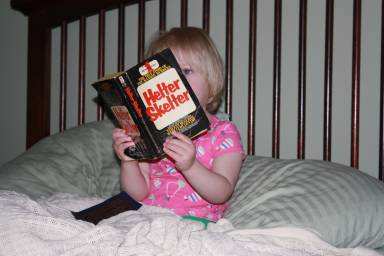
Usually, when a 2 year old says, “Where’s my clown book?” she is not refering to It by Stephen King. Not so at our house. Evie likes to go for the thrillers:

See, I have a LOT of Stephen King books, particularly hardcovers. These are very heavy. So, on one of our book shelves, we put all the Stephen King books on the bottom shelf, so they don’t bend the actual shelf. These books are right at Evie’s height, and she has claimed them as hers. (Yes, I realize Helter Skelter isn’t by Stephen King, she stole that one from my nightstand) (Yes, Helter Skelter was on my nightstand)

I think all of this exposure to horror novels has rubbed off on her. Frequently she will take one of these books and “read” it to us by making up a story. Despite having never actually heard a scary story, she reads these stories in the most dramatic tone she can manage, kind of like a cheap radio drama. However, there is never any payoff, just suspense. For example, “And THEN! She looked into Pa’s sharp eyes…and they went around the corner…and Ma said, “I am so surprised!”…so she climbed a tree….and there was a WOLF in the tree!…so they decided to go in for supper…” Etc. etc.

In regards to reading in general, Evie has taken to narrating her life like a book. For example, when she realized I had put her into bed but not covered her up, she exclaimed, “Then, a minute later, I realized something!” and got under the covers. Another example is sort of talking through her actions before she does them, such as saying to a little kid on the playground, “well, I always like to introduce myself, so…” and then introducing herself to that person.

She also uses this when she needs a scene change. For example, the other night we were playing school in the bath:
Me: “What comes after eleven?”
Evie: “Ten”
Me: “No, but what comes after eleven?”
Evie: “Ten!”
Me: “Okay, then what comes after ten?”
Evie: “…”
Evie, grabbing a boat: “And then suddenly a boat floated by!”

I love all the exposure she has to books. There is something so adorable about a little kid who uses words and grammar more correctly than I do!