Coconut Pancakes with Pineapple Sauce

The Reason:

I swear I didn’t intend to do another pancake post. I’m going to have to rename the feature to First Friday Pancakes! I planned to do an item from baconfest, but, sadly, none of the recipes were really phenomenal enough to blog about (plus the pictures didn’t turn out that well).

So here we find ourself with yet another pancake recipe, but I promise you, this is one you don’t want to miss!

The Journey:

Some people are turned off by the fact there is coconut in this recipe.Do not come in expecting super coconut flavor! This isn’t an Almond Joy. The coconut flavor is very mild, although some people don’t like the texture of coconut, so in that case I guess this might not be for you. However, I’ve served these to many self-proclaimed coconut-haters, who ultimately love these pancakes.


The other interesting part is the pineapple sauce, which you use instead of syrup. To me this is the best part. You could really put the sauce on any pancakes, but it does seem to go especially well with the coconut. The whole thing is sort of a tropical, island-y theme.


As to the pancakes themselves, they are very thick, so you have to cook them for a long time. Because of the coconut, they don’t bubble up like regular pancakes. I find it’s best to cook it for a while on one side, flip it and pat it down, cook it on the other side, and then flip it back to the first side again. Otherwise it can be difficult to make sure everything cooks through.

The Verdict:

These are HEAVENLY! I might go so far as to say these are the best pancakes I have ever had. They are also a very nice change of pace, since they are different than any of the other pancake recipes in our stable. They’re also pretty dense, and vegan to boot! What’s not to love?

The Recipe:

The recipe is originally from the “Vegan with a Vengeance” cookbook.

Coconut Pancakes:

1 1/4 cups whole wheat flour
2 t baking powder
1/2 t salt
1 t nutmeg
1/3 cup water
1 1/4 cup soy milk
2 T maple syrup
1 t vanilla extract
2 T canola oil
1 cup unsweetened shredded coconut

Mix the dry ingredients in a large bowl, followed by the wet ingredients, followed by the coconut.

If you don’t know how to cook pancakes by now, you’re coming to the wrong blog.

Pineapple Sauce:

20-oz can of crushed pineapple
2 T arrowroot powder (we substituted 2 T corn starch)
3 T sugar
1 t vanilla extract

Cook the sauce for ~7 minutes, until it thickens. Make sure you stir this a lot, or it will burn to the bottom of the pan.

Slow-Rise Pancakes

The Reason:

As has been established previously, pancakes are very serious business in our house. Though we have a couple of good solid base recipes, we are always on the lookout to try something different. As always with new recipes, you win some and you lose some.

This one was a winner!

The Journey:

The interesting thing about these pancakes is that you use yeast. I’ve seen a lot of pancake recipes, but this is the first one I’ve ever seen that requires yeast. It doesn’t really rise, per say, but you do end up making something that is more of a dough, not a batter. It’s more like frying bread dough.

You can try to thin the dough with a little bit of milk, but it doesn’t seem to make much of a difference, so I don’t know if it is even worth it. Basically, the whole thing is just very different than making regular pancakes, so you can’t really expect the batter to be the same consistency.

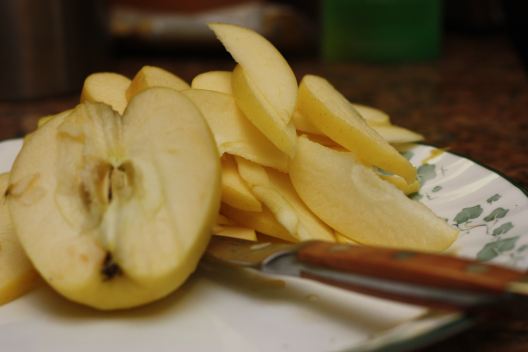
The other very appealing thing about these pancakes is apple slices! Sure, you could put apple slices on any pancake, or you could put something besides apples on these pancakes, but they looked so good in the recipe, that I just went with it and it worked.

The yeast makes this like a chemical reaction, changing the consistency of things. I think it actually makes the dough sweeter, but it also makes very thick pancakes. You have to make sure you flatten them a lot when you flip them over. Also, because they’re so thick and chewy, they are hard to cook through, especially where the apples are. So you want to be careful to make sure they aren’t too doughy in the middle.

The Verdict:

These things are rib-stickers! Very filling, in addition to being delicious. The apples are a really good idea, though as I said, you could really do that on any set of pancakes. These won’t replace our baseline pancakes, but they are definitely now a part of our normal pancake rotation. You do have to start them the night before, so they take some pre-planning.

The Recipe:

The original recipie can be found at Vegan Yum Yum (which is pretty awesome by the way).

2 cups white whole wheat flour
1 1/2 T vital wheat gluten
1 1/4 t yeast
1/2 t salt
2 t sugar
1 1/2 cups milk
1 T oil
1 egg

Mix the dry ingredients first, and then mix in the milk, oil and egg. Cover the bowl with plastic wrap and leave it in the fridge overnight.

If you’re going to be doing the apples, try to cut them thin so the pancake underneath will still get some heat.

The rest is just like making regular pancakes.

Cinnamon-Roasted Nuts

The Reason:

I don’t actually remember how we stumbled upon this recipe to begin with. However, I do have a reason for selecting it as this month’s recipe. Originally this was supposed to be last month’s post, because we brought these nuts with us over Christmas, and they were a big hit. At least one person even said they didn’t like nuts, but they liked these. Many people were asking for the recipe, so I wanted to post this one right after Christmas, however, I couldn’t get the pictures due to a combination of a little procrastination and an electrical mishap destroying our oven.

So, without further ado, here’s the recipe. I hope it isn’t too late for anybody who wanted it!

The Journey:

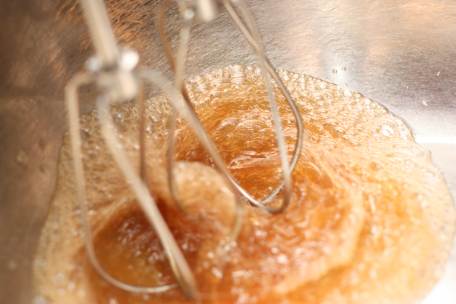
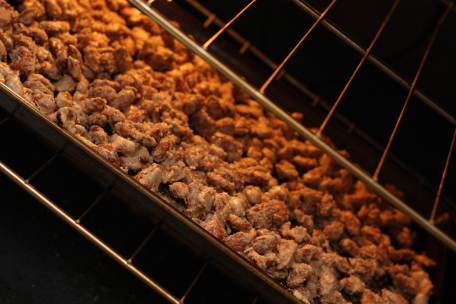
These are actually super easy to make. You just sort of mix everything in a bowl and then bake it. Probably the hardest part is getting an egg white. First you whip the egg white, and then use that to coat the nuts.

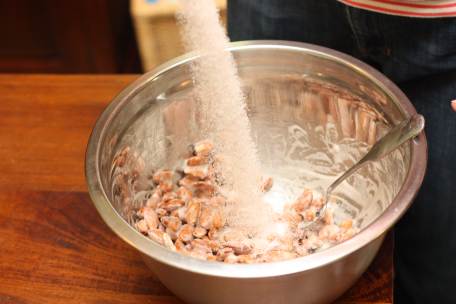
After the nuts are coated, you add the rest of the ingredients.

The recipe calls for pecans, which is how Sara likes it best, but I prefer almonds. I don’t think there is a consensus about what’s the best, so I guess it just depends on what you like.

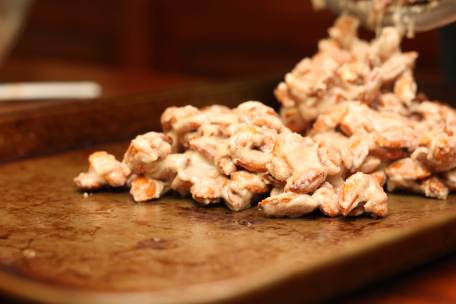
Put everything on a pan and bake it just short of forever, stirring periodically. It doesn’t really start to look like the correct consistency until right at the end, maybe about the last time you stir it.

The Verdict:

Irresistible! If these things are in front of you, you cannot stop eating them. The only way to stop yourself is to not make them in the first place. You’d be amazed at how fast a pound of nuts can disappear!

The Recipe:

The original recipe was from AllRecipes.com.

  • 1 egg white
  • 1 tablespoon water
  • 1 pound pecan halves
  • 1 cup white sugar
  • 3/4 teaspoon salt
  • 1/2 teaspoon ground cinnamon

Directions

  1. Preheat oven to 250 degrees F (120 degrees C). Grease one baking sheet.
  2. In a mixing bowl, whip together the egg white and water until frothy. In a separate bowl, mix together sugar, salt, and cinnamon.
  3. Add pecans to egg whites, stir to coat the nuts evenly. Remove the nuts, and toss them in the sugar mixture until coated. Spread the nuts out on the prepared baking sheet.
  4. Bake at 250 degrees F (120 degrees C) for 1 hour. Stir every 15 minutes.

Cold Brewed Coffee

It’s the first Friday of February, and that means a new First Friday Food post!

The Reason:

My mom and grandma have a Toddy, which is a cold-brewing system for coffee. They swear by this thing, and it intrigued me. Basically you make a concentrated coffee syrup, which you can reconstitute with water at a later date to make coffee.

Upon investigation, cold brewing coffee is a pretty popuplar thing. According to what I saw on the Internet, there are two main advantages of doing this: you can use just as much as you need, instead of making a pot and throwing away the leftovers, and it actually has different properties than regular coffee, specifically, it tastes smoother, and less acidic.

I also discovered online that you can make this pretty easily without buying any sort of equipment. So we decided to give it a go.

The Journey:

Step 1 was to buy the coffee. To make this work, you need coarse grounds. This meant buying beans and using the coffee grinder at the store, which kind of terrified me. However, I managed to not make too much of a fool of myself. We went with the rich and bold dark roast from Trader Joe’s.

The way this works is that you soak the grounds in cold water for about 12 hours. This is what makes the concentrated syrup, and also why it tastes different than traditional, hot-brewed coffee.

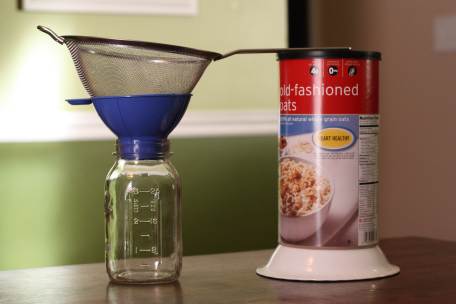
After the coffee has been sitting, you need to strain out the grounds. A commercial system like the Toddy comes with filters, but we had to invent our own setup.

Next up is to filter the concentrated coffee through a regular coffee filter. Having something to hold up the filter is key, because this is a long slow process, and you are NOT going to be able to hold it the entire time. One tip we learned after making this once was to do a first pass on the grounds with just a close-knit, mesh strainer. This gets 99% of the grounds out, so the rest will go through the coffee filter faster.

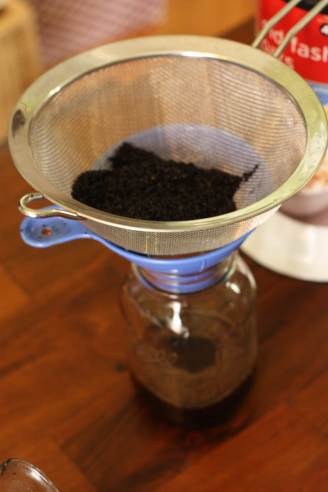
The next part is to just put it through the filter.

This will take a LONG time (we’re talking hours), so you just pour some in and then go away for a while. At first it will go through the filter faster, but as you go along, the filter gets a build-up on it, which makes it go slower.

EDIT: Using cheese cloth instead of paper filters improves this time from around 2 hours, to around 1 minute!

The Verdict:

Awesome.

It certainly does taste different than regular, hot-brewed coffee. If you were comparing cold-brewed to hot-brewed straight up, then it would just be a matter of personal preference. For me, the hot stuff tastes just as good, though different. However, the cold stuff has other advantages.

By far the biggest advantage has to do with the options it provides you: the coffee concentrate is fantastic for coffee flavored drinks. After we figured this out, we never used it for regular coffee. At the very least, we made it with hot milk instead of water. This gives you a café au lait that is the equivalent of anything you’d get at a shop. You can make delicious iced coffee drinks. You also have the ability to control the amount of coffee flavoring you want, so it allows you to make really strong coffee too. In short, making regular old coffee with the concentrate is really only the beginning, and probably the least of what you’d want to do with it.

Once Sara tasted cold-brewed coffee made with milk, she never wanted coffee any other way.

There are also advantages for the casual coffee drinker, such as being able to make one cup here or there when you want it. It is certainly faster and cheaper than making an entire pot and then throwing away half of it.

The Recipe:

There’s not really a recipe per say. Put coarse ground coffee in a pot of cold water in the fridge overnight, and then filter it. The 1st time we did it, we used 5 cups of water to 1/2 lb coffee. The second time we used 10 cups water for the same amount of coffee. All that happened was that we had weaker concentrate, so we had to use twice as much to make a cup. In other words, stick to the 5 cups of water. This is especially true since the hard part is putting it through the filter. With the 10 cups of water, it took ~2 hours to go through coffee filter. So don’t waste the time with all the extra filtering, stick to the 5 cups of water.

I don’t have a precise measurement on how much of the concentrate to use with a cup. It depends on the type of coffee, the concentration of water, etc. I would say, in general, you need about a double finger’s width of coffee in a large coffee mug. More or less to taste.

Repost: Pumpkin Pioneer Pancakes

Note that this post originally appeared on Cheap, Healthy, Good, but I reposting it here for posterity’s sake.

Shane can be found at ShaneHalbach.com, blogging about the zombie apocalypse, bacon, and his adorable kids (not necessarily in that order).

My daughter Evie likes pancakes. A lot. It’s not really Sunday at our house if you’re not in your PJs at noon eating pancakes while batter slowly drips off your daughter (and the stove, and the walls…). I can’t say I blame her, they’re fun to make, they’re delicious, and they’re really not that bad for you.

(This is assuming you don’t put chocolate chips inside and then slather them with whipped cream and who knows what else – I mean, you can do that, I’m not judging. I won’t even call the health police on you. However, if she was going to be eating pancakes that often, I figured we should at least try.)

So why are they “pioneer” pancakes? Well, anyone who has kids knows that the first component to a successful meal, especially one they don’t want to eat, is marketing. (Yes, we had to sell our daughter on the idea of pancakes. Kids are funny that way. I’m sure she wouldn’t believe it now either.) One of the main components of the recipe is substituting molasses for sugar, since molasses is a mineral-dense sweetener, particularly for calcium and iron. My daughter and I were reading the Little House on the Prairie books, and they mentioned eating molasses as a topping for pancakes. Voilà, marketing slogan established!

Evie, helping me make pancakes: “Are we going to put that in now? The other thing?”
Me: “What thing?”
Evie: “The icky sticky goo?”

Well, apparently I can’t add molasses to anything without singing, “Molasses, molasses, icky sticky goo! Molasses, molasses, it’ll always stick to you!” A song that fun was not going to go unnoticed.

As far as I’m concerned, there aren’t a lot of things that can’t be improved with the addition of pumpkin (and there’s not a lot of other ways to sneak vegetables unnoticed into breakfast). And I throw some walnuts in there too for good measure (“Brain Food”…it looks like your brain and it’s good for it too! There should be a requirement that all ad execs have to have prior experience as a parent.) Use whole wheat flour and you’re in business!

We usually make a triple batch and freeze them on cookie sheets, before putting them in big freezer bags. Then we can reheat one or two at a time for a quick breakfast during the week. Because, hey, if you could get away with eating pumpkin pioneer pancakes for breakfast every morning, you would too!

Pioneer Pumpkin Pancakes
Feeds 3 hungry people (12 – 14 medium-sized pancakes)

1 egg
1 1/4 cups buttermilk
1/2 tsp baking soda
1 tsp baking powder
1 tbsp black strap molasses
1 tbsp canola oil
1/2 cup pumpkin
1 tsp pumpkin pie spice
1 1/4 cups white whole wheat flour
1/4 cup walnuts

1) Beat egg in a large mixing bowl.

2) Beat in buttermilk, baking soda, baking powder, molasses, canola oil, pumpkin and pumpkin pie spice.

3) Beat in whole wheat flour. I just hand mix it (but then again Evie doesn’t mind if it is a little lumpy). You might notice that the batter is pretty dark thanks to the whole wheat flour and the molasses.

4) Add water to thin batter if necessary.

5) Heat skillet. You could hypothetically do this at the same time as mixing the batter, unless you also have to manage a 3 year old.

6) Oil the skillet. I usually do this about every other batch of pancakes or so.

7) Use a large spoon to make whatever size pancakes you want.

8 ) Sprinkle a handful of walnuts on each pancake. You could mix it into the batter, but I like to put it into the pancakes manually so the walnuts are evenly spread. I find that if you mix them into the batter, you end up with the last few pancakes being walnut city.

9) Flip the pancakes when bubbles rise to the top and the edges look a little crispy.

NOTE: All of the following calculations come from Kris (the proprietor of CHG), instead of Shane (author of the guest post). Please e-mail her/me if there are any issues. Thanks!

Approximate Calories, Fat, Fiber, Protein, and Price Per Serving
382 calories, 15.4 g fat, 8.1 g fiber, 14.6 g protein, $0.99

Calculations
1 egg: 54 calories, 3.7 g fat, 0 g fiber, 4.7 g protein, $0.33
1 1/4 cups buttermilk: 172 calories, 6.1 g fat, 0 g fiber, 12.6 g protein, $0.62
1/2 tsp baking soda: negligible calories, fat, fiber, and protein, $0.01
1 tsp baking powder: 2 calories, 0 g fat, 0 g fiber, 0 g protein, $0.01
1 tbsp black strap molasses: 47 calories, 0 g fat, 0 g fiber, 0 g protein, $0.13
1 tbsp canola oil: 124 calories, 14 g fat, 0 g fiber, 0 g protein, $0.08
1/2 cup pumpkin: 42 calories, 0.4 g fat, 3.6 g fiber, 1.3 g protein, $0.33
1 tsp pumpkin pie spice: 6 calories, 0.2 g fat, 0.3 g fiber, 0.1 g protein, $0.70
1 1/4 cups white whole wheat flour: 509 calories, 2.8 g fat, 18.3 g fiber, 20.5 g protein, $0.27
1/4 cup walnuts: 191 calories, 19.1 g fat, 2 g fiber, 4.5 g protein, $0.50
TOTAL: 1147 calories, 46.3 g fat, 24.2 g fiber, 43.7 g protein, $2.98
PER SERVING (TOTAL/3): 382 calories, 15.4 g fat, 8.1 g fiber, 14.6 g protein, $0.99